
- Microservices aren't a prerequisite for modernization. Rather, they require serious operational commitment — more infra cost, more moving parts, more skills needed.
- It only pays off for specific situations: independent release cycles, divergent scaling needs, domain-owned teams, genuine cloud-native strategy. Most of what pushes companies toward microservices are technical debt, slow releases, poor visibility.
- They can actually be fixed through refactoring, cloud migration, API enablement, database tuning, and automation, without full decomposition.
- The right approach: start with business questions — growth, release bottlenecks, risk, cost, integration needs — not "should we do microservices?"
In the last decade, microservices have become the go to modernization recommendation for enterprise software systems. Ask any SaaS architecture team what "modernization" means, and the answer usually starts with breaking things apart. Organizations often assume that moving away from a monolithic architecture is a prerequisite for scalability, cloud adoption, and innovation.
In reality, many organizations successfully operate large-scale, business-critical applications on well-engineered monolithic systems with some processing millions of transactions a day without a single microservice in sight. The real challenge is rarely the architecture itself. It's years of accumulated technical debt, outdated workflows, unsupported technologies, and limited operational visibility. Microservices don't fix any of that automatically; they just relocate the problem, and sometimes multiply it.
Modernization should begin with business objectives, not architectural trends. To know more about how we do it, check out our InComm Payments case study: InComm Payments Case Study
When Monoliths Become a Problem
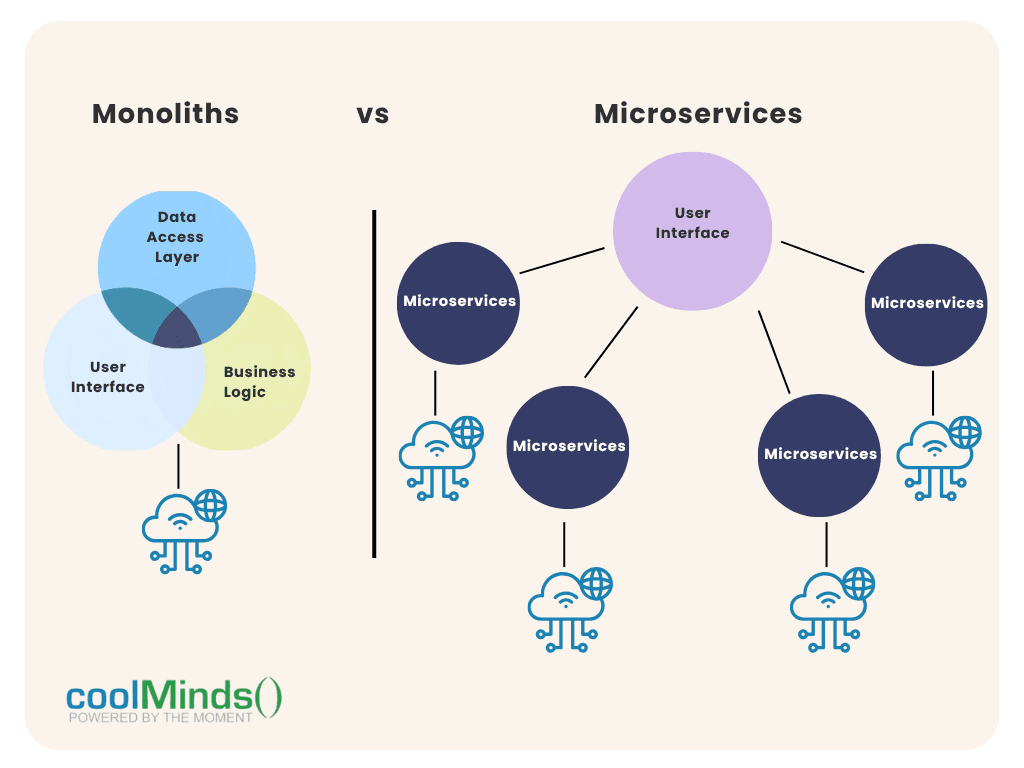
A monolith is not automatically a flawed design pattern. The real warning signs that a legacy system needs attention have very little to do with whether it's monolithic — you need to look for some red flags:
- Slow release cycles
- Growing maintenance costs
- Lack of automated testing
- Knowledge concentrated in a few individuals
- Difficult integrations
- Infrastructure limitations
- Poor user experience
Here's the part most modernization pitches skip: every one of these problems can exist in a microservices environment too. Most times testing is skipped or overlooked, documented poorly which ultimately places the monolith into silos of poorly tested and documented services. This doesn't solve the underlying issue that legacy systems had in microservices, rather it just gives it twenty places to hide.
The Hidden Costs of Microservices
Microservices solve real problems for the right organizations. But the decision is often made based on topographical architecture rather than checking on operational costs that would be incurred. Before committing to a microservices migration, it's worth being honest about what it actually requires.
- Increased operational complexity. A single application becomes dozens of independently deployed services. Each one now needs its own monitoring, logging, security controls, deployment pipeline, and version management. What was one thing to operate becomes dozens of things to operate almost all at once and all the time.
- Higher infrastructure costs. Organizations routinely underestimate the cost of container platforms, Kubernetes management, networking overhead, and cloud consumption at scale. The infrastructure bill for "modern" architecture can quietly outpace the cost of the legacy system it replaced.
- More complex troubleshooting. Finding a performance issue in one well-understood application is often far simpler than tracing a single request across a dozen interconnected services, each with its own logs, latency profile, and failure modes.
- New skill requirements. Teams now need to manage containers, service meshes, API gateways, distributed tracing, and event-driven architectures — specialized skills that take time to build and aren't always available in-house.
None of this means microservices are a mistake. It means they're a serious operational commitment, not a checkbox on a modernization roadmap.
Modernization Without Full Decomposition
Here's what often gets lost in the "monolith vs. microservices" framing: most modernization goals can be achieved without breaking an application into dozens of services at all.
- Application refactoring improves maintainability and code quality while preserving the business logic that already works without requiring architectural rewrite.
- Cloud migration moves workloads onto modern infrastructure without redesigning the entire application from scratch, unlocking elasticity and resilience on its own.
- API enablement exposes legacy functionality through modern REST or GraphQL interfaces, letting new applications and partners integrate with the system without touching its internals.
- Database optimization: indexing, query tuning, right-sizing, read replicas — and it often solves the scalability problems that get blamed on "the architecture" in the first place.
- Automation reduces manual operational effort through workflow automation and system integration, often delivering more measurable ROI than a re-architecture would.
- AI readiness prepares legacy systems for AI-assisted workflows and analytics by cleaning up data access patterns and exposing the right interfaces without requiring a ground-up rebuild.
Each of these delivers real modernization value on its own. Combined, they can resolve the majority of what actually drives organizations toward microservices in the first place — usually without the operational overhead that comes with full decomposition.
A Practical Modernization Framework
Instead of starting with "should we migrate to microservices?", CoolMinds determines that there are certain fact-finding foundational queries to be answered to determine whether an architecture change is warranted:
- Can the current platform support projected growth?
- Are releases becoming a business bottleneck?
- Is operational risk increasing?
- Are maintenance costs rising faster than the business can absorb?
- Can the system integrate with modern technologies and partners?
- Is customer experience being measurably affected?
Only after answering these questions honestly should architectural decisions get made. In many cases, the answer points toward targeted application modernization rather than a full microservices architecture overhaul.
When Do Microservices Actually Make Sense
To be clear: microservices are the right call in plenty of situations. They tend to earn their complexity when:
- Teams need independent release cycles across different parts of the product
- Different modules have significantly different scaling requirements
- Multiple products share common capabilities that benefit from being centralized services
- Large engineering organizations need clear domain ownership across teams
- Cloud-native operations are a genuine strategic priority, not just a talking point
The key is ensuring the architecture aligns with business needs rather than industry trends. When those conditions are real, a well-planned microservices adoption strategy can be transformative. When they're not, it's often an expensive solution to a problem the organization does not have in the first place.
The CoolMinds Approach
At CoolMinds, modernization begins with understanding business objectives, operational constraints, and long-term technology goals.
We help organizations evaluate their existing systems, identify where technical debt is actually causing business impact, and implement pragmatic modernization strategies that balance innovation, risk, and operational continuity. For some organizations, that means a phased microservices migration. For others, it means modernizing and extending the systems they already have. This helps them create more value out of the entire transition for years to come.
The ultimate goal is to build technology platforms that keep delivering business value. Where competitors sell you an architecture, we start with your problem then figure out what actually solves it.
Not sure whether your platform needs a rebuild or a refactor?
Get a free, no-cost technical assessment of your current architecture from CoolMinds' modernization team. We'll help you identify exactly where technical debt is costing you the most and what a realistic modernization path looks like for your business.
Book Your Free $0 Technical Consultation